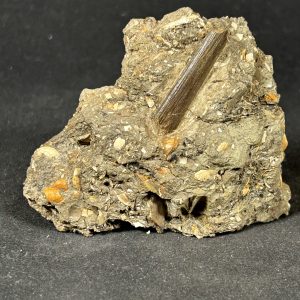
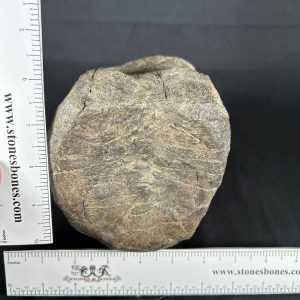
Brachylophosaurus fossil bones are exceptionally well preserved specimens from one of the most completely known hadrosaurs of the Late Cretaceous.
Quick Facts
| Common Name: Brachylophosaurus | Scientific Name: Brachylophosaurus canadensis | Meaning: Short-crested lizard |
| Period: Late Cretaceous (77-74 million years ago) | Diet: Herbivore | Size: Large |
| Length: Up to 11 meters (36 feet) | Weight: 7-8 tons | Named by: C.M. Sternberg, 1953 |
Overview
Brachylophosaurus was a large flat-crested hadrosaur that lived in what is now Montana and Alberta during the Late Cretaceous period. It is one of the most completely known hadrosaurs thanks to several exceptional mummified specimens including the famous “Leonardo” specimen which preserved skin, scales, muscle tissue and stomach contents. These remarkable fossils have provided an unprecedented window into the soft tissue anatomy and diet of a large dinosaur.
Exceptional preservation
Mummified Brachylophosaurus specimens from Montana have allowed scientists to reconstruct skin texture, muscle arrangement, and diet in ways that would otherwise be impossible — making this species one of the best-understood large dinosaurs in terms of soft-tissue anatomy. The Royal Tyrrell Museum’s research team has been central to understanding hadrosaurine biology from the Alberta–Montana corridor, publishing extensively on hadrosaur life-history, skin impressions, and footprint morphology.
What to Look For
Brachylophosaurus vertebrae from the Late Cretaceous of North America offer a tangible connection to one of the most scientifically important hadrosaurs ever found — a species known for extraordinary soft-tissue preservation in mummified specimens. Some pieces come with associated teeth, giving collectors both structural bone and direct evidence of this animal’s remarkable dental system. As a hadrosaurine — a flat-headed rather than crested hadrosaur — Brachylophosaurus represents the “workhorse herbivore” of the Late Cretaceous, the most abundant large plant-eater of its time and place.
Look for the distinctive flat paddle-like crest that lies along the top of the skull. Hadrosaur bone is typically dense and well mineralized. Skin impression fossils occasionally accompany skeletal material. Teeth are battery-style and self-replacing. Vertebrae have distinctive tall neural spines.
Fun Facts
The Leonardo specimen is one of the best preserved dinosaur fossils ever found, with soft tissue preserved over 90% of the body. Stomach contents revealed Brachylophosaurus ate ferns, conifers and flowering plants. Skin impressions show a pebbly texture across most of the body. It is sometimes called a “living snapshot” of a Cretaceous dinosaur.
Museum Research Articles
Learn more about the Brachylophosaurus
- Royal Tyrrell Museum: Research Program
- Natural History Museum London: Dino Directory
- Britannica: Hadrosaur