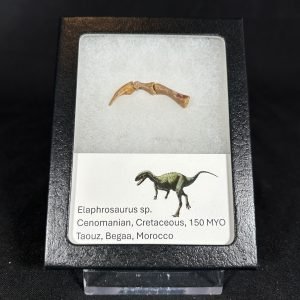
Elaphrosaurus fossil bones are exceptionally rare specimens from one of the most lightly built and enigmatic theropod dinosaurs of the Late Jurassic period.
Quick Facts
| Common Name: Elaphrosaurus | Scientific Name: Elaphrosaurus bambergi | Meaning: Light-footed lizard |
| Period: Late Jurassic (154-150 million years ago) | Diet: Carnivore | Size: Medium |
| Length: Up to 6 meters (20 feet) | Weight: 200-250 lbs | Named by: Werner Janensch, 1920 |
Overview
Elaphrosaurus was a lightly built ceratosaurian theropod dinosaur that lived in what is now Tanzania during the Late Jurassic period. It was discovered during the famous Tendaguru expeditions led by Werner Janensch between 1909 and 1913, which yielded some of the most spectacular African dinosaur fossils ever found. Known primarily from a single skeleton lacking a skull, Elaphrosaurus remains one of the most mysterious African dinosaurs. Recent discoveries of related ceratosaurans suggest it may have been omnivorous or even herbivorous in adulthood rather than purely carnivorous.
A shifting scientific story
Its close relationship to the Chinese Limusaurus — which became toothless and plant-eating as an adult — has led researchers to propose Elaphrosaurus may itself have been herbivorous or omnivorous despite being a theropod. The skull has never been found, making definitive diet assessment impossible. The Smithsonian Institution holds Elaphrosaurus material in its paleobiology collection. Any genuine Elaphrosaurus specimen is exceptionally rare.
What to Look For
Elaphrosaurus hand claws are extraordinarily rare. The entire genus is known primarily from a single partial skeleton recovered over a century ago from the Tendaguru Beds of Tanzania. Any genuine Elaphrosaurus material places you in direct contact with one of paleontology’s most fascinating unsolved puzzles — a Jurassic theropod whose diet, relationships, and lifestyle continue to be actively debated by the world’s leading paleontologists. The gracile, lightweight structure of Elaphrosaurus bones reflects its reputation as a fast, agile animal built more for speed than brute force.
Look for the slender gracile limb bones characteristic of lightly built ceratosaurans. Bone surface shows typical theropod texture.
Fun Facts
Elaphrosaurus was discovered alongside the giant sauropod Giraffatitan in Tanzania making it one of the few theropods known from the same formation as the largest dinosaurs. Its skull has never been found making diet and lifestyle uncertain. A related species Elatosaurus was recently discovered in Australia suggesting ceratosaurans were more widespread than previously thought. The Tendaguru formation where it was found is one of the richest Jurassic fossil sites in Africa.
Museum Research Articles
Learn more about the Elaphrosaurus
- Natural History Museum London: Dino Directory
- Smithsonian Institution: Collection