Enchodus fossil teeth and bones are among the most striking predatory fish specimens available to collectors, representing one of the most successful and widely distributed fish predators of the Cretaceous seas.
Quick Facts
| Common Name: Enchodus | Scientific Name: Enchodus petrosus | Meaning: Lance tooth |
| Period: Cretaceous to Eocene (100-37 million years ago) | Diet: Carnivore | Size: Small to Medium |
| Length: Up to 50 cm (20 inches) | Weight: Under 5 lbs | Named by: Cope, 1868 |
Overview
Enchodus was a small to medium-sized predatory fish that thrived in the oceans and shallow seas of the Late Cretaceous and Early Eocene worldwide. Known colloquially as the sabre-toothed herring it had enormous fang-like teeth at the front of its jaws completely disproportionate to its body size making it one of the most distinctive fossil fish available to collectors. Despite its fearsome dentition Enchodus was itself prey for larger predators including mosasaurs, sharks and large birds. Its fossils are found on every continent making it one of the most globally distributed Cretaceous fish.
What to Look For
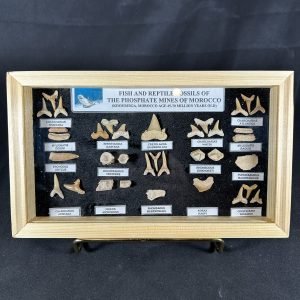
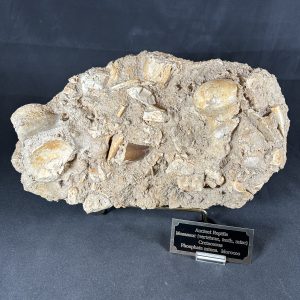
Enchodus teeth are the most commonly available specimens and immediately recognizable — large blade-like fangs with a flattened oval cross section, sharp cutting edges and a distinctive curve. The enamel is smooth and often well preserved. Teeth from the Moroccan phosphate deposits are the most common on the market and typically tan to brown in color. Kansas chalk specimens tend to be darker. Complete jaw sections with multiple teeth are particularly striking display specimens.
Fun Facts
Enchodus is nicknamed the sabre-toothed herring for its enormous fang-like front teeth which could be longer than the fish’s own skull. It was prey for mosasaurs, plesiosaurs and the giant fish Xiphactinus despite being a formidable predator in its own right. Its fossils have been found on every continent including Antarctica making it one of the most geographically widespread Cretaceous vertebrates. Enchodus survived the end-Cretaceous mass extinction and persisted into the Eocene before finally going extinct around 37 million years ago.
Museum Research Articles
Learn more about the Enchodus
- Lyme Regis Museum: A Wonderful Example of a Fossil Fish
- Britannica: Enchodus