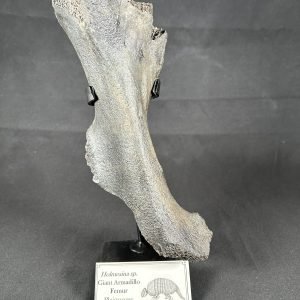
Glyptodon fossil bones and shell fragments are among the most visually striking prehistoric mammal specimens available, representing one of the most bizarre and heavily armored creatures of the Pleistocene epoch.
Quick Facts
| Common Name: Glyptodon | Scientific Name: Glyptodon clavipes | Meaning: Carved tooth |
| Period: Pleistocene (2.6 million-10,000 years ago) | Diet: Herbivore | Size: Very Large |
| Length: Up to 3.3 meters (11 feet) | Weight: 1-2 tons | Named by: Owen, 1839 |
Overview
Glyptodon was a massive armadillo-like mammal that lived across South America and southern North America during the Pleistocene epoch. Encased in a rigid dome-shaped shell made of hundreds of interlocking bony plates called osteoderms it was one of the most heavily armored mammals ever to have lived. Related to modern armadillos it could reach the size of a small car. Early humans coexisted with Glyptodon in South America and there is evidence they may have used the shells as shelters. Its massive bony tail club could be swung as a weapon against predators or rival Glyptodons.
What to Look For
Individual osteoderm plates from the shell are the most commonly available Glyptodon specimens and are highly distinctive — look for the characteristic hexagonal shape with a central raised boss and a ring of smaller pits around the edge. Each plate fits into its neighbors like a puzzle piece. Genuine plates are dense and heavy for their size. Complete or partial carapace sections are exceptional specimens. Tooth fragments are also sometimes available — the teeth are distinctive prismatic columns.
Fun Facts
Early humans in South America may have used Glyptodon shells as shelters and tools leaving behind archaeological evidence inside fossil shells. Its shell was made of over 1,000 individual interlocking bony plates each roughly hexagonal in shape. Glyptodon was so heavily built that its spine was partially fused to support the weight of its shell. Its tail club could shatter bone and was likely used in combat between males. Modern armadillos are its closest living relatives though they are much smaller.
Museum Research Articles
Learn more about the Glyptodon
- Britannica: Glyptodon