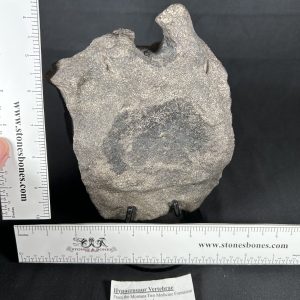
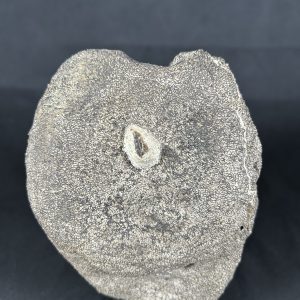
Hypacrosaurus fossil bones are among the most complete hadrosaur specimens available to collectors, representing one of the best understood duck-billed dinosaurs of the Late Cretaceous.
Quick Facts
| Common Name: Hypacrosaurus | Scientific Name: Hypacrosaurus altispinus | Meaning: Near the highest lizard |
| Period: Late Cretaceous (75-67 million years ago) | Diet: Herbivore | Size: Large |
| Length: Up to 9 meters (30 feet) | Weight: 4-5 tons | Named by: B. Brown, 1913 |
Overview
Hypacrosaurus was a large crested hadrosaur that lived in what is now Alberta, Canada and Montana during the Late Cretaceous period. It is one of the best-understood hadrosaurs thanks to exceptional specimens recovered by the Royal Tyrrell Museum including juveniles, eggs, and nesting sites. Research on Hypacrosaurus growth rates has revolutionized our understanding of how quickly large dinosaurs grew to maturity.
Royal Tyrrell Museum research
In 2024, Royal Tyrrell Museum scientists published research on Hypacrosaurus stebingeri demonstrating evidence of age segregation behaviour — young and old individuals living in different areas — based on taphonomic comparison of bonebeds from Alberta and Montana. Studies have shown that Hypacrosaurus reached adult size in as little as seven to eight years, reflecting rapid growth rates more comparable to birds and mammals than to cold-blooded reptiles.
Exceptional fossil record
Hypacrosaurus has one of the most complete fossil records of any dinosaur, from embryo to adult. Complete skeletons at multiple growth stages have been recovered, providing a rare window into how these animals developed. Nesting sites and egg fossils associated with hadrosaurs have contributed significantly to our understanding of dinosaur reproductive behaviour and potential parental care.
What to Look For
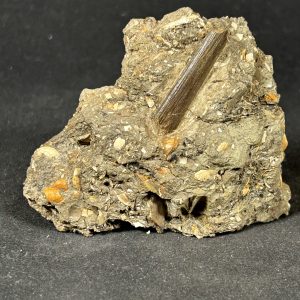
Hypacrosaurus vertebrae are genuine pieces of the rich Late Cretaceous fossil record of the North American interior. Some specimens come with associated teeth still in place, giving collectors two types of evidence in a single piece: the structural bones that supported this large animal and the teeth that powered its extraordinary plant-processing dental battery. The hollow-crested hadrosaurs were among the most abundant large animals of their time, and their vertebrae are often well-preserved due to their dense, compact construction.
Look for the distinctive tall neural spines on the vertebrae that give the animal its name. Hadrosaur bone is typically dense and well preserved. Teeth are battery-style with hundreds of replacement teeth stacked in rows. The hollow crest fragments are thin-walled and distinctive.
Fun Facts
Hypacrosaurus grew faster than any living animal of comparable size. Nesting colonies have been found suggesting highly social behavior. Juveniles were remarkably small at hatching and grew at extraordinary rates. The hollow crest was likely used for visual display and possibly sound production.
Museum Research Articles
Learn more about the Hypacrosaurus
- Royal Tyrrell Museum: Research Program
- Natural History Museum London: Dino Directory
- Britannica: Hadrosaur Herding Behaviour
- Royal Tyrrell Museum: Dr. Therrien Research