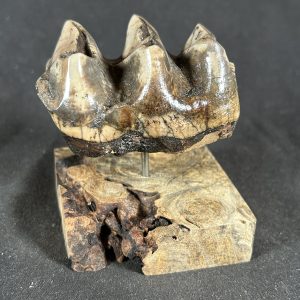
Deinotherium fossil teeth and bones are among the rarest prehistoric mammal specimens available, belonging to a completely separate branch of the elephant family tree that vanished without leaving any living descendants — distinguished from all other proboscideans by its extraordinary downward-curving lower tusks and tapir-like teeth.
Quick Facts
| Common Name: Deinotherium | Scientific Name: Deinotherium giganteum | Meaning: Terrible beast (from Greek) |
| Period: Miocene to Early Pleistocene (17–1 million years ago) | Diet: Herbivore | Size: Very large — among the largest land mammals ever |
| Length: Up to ~7 m (23 ft) body length | Weight: Up to ~12 tons | Named by: J.J. Kaup, 1829 |
Overview
Deinotherium was a giant proboscidean — a distant relative of modern elephants — that ranged across Africa, Europe, and South Asia from the Middle Miocene to the Early Pleistocene. Among the largest land mammals ever to have lived, several species reached shoulder heights of 4 metres and body masses of 12 tonnes, considerably exceeding modern African elephants in size. Despite superficial similarities to elephants, Deinotherium belonged to an ancient and separate family — the Deinotheriidae — that diverged from the main proboscidean line early in its history and left no living descendants.
Its most immediately distinctive feature was its tusks: two curved tusks projecting downward and backward from the lower jaw only, with no tusks in the upper jaw at all — the opposite arrangement from mammoths, mastodons, and modern elephants. This unique tusk configuration is thought to have been used for stripping bark from trees or hooking and pulling down branches, working in conjunction with Deinotherium’s notably flexible neck to apply force while foraging in dense forest environments.
Deinotherium was a dedicated browser, feeding on leaves and soft vegetation. Its teeth were bilophodont — bearing two transverse ridges similar to modern tapir teeth — suited to processing forest browse rather than the tough grasses that later proboscideans evolved to exploit. Its eventual extinction is attributed to the progressive replacement of African forests by open grasslands during the latter Neogene.
What to Look For
Deinotherium molar teeth are the most commonly available specimen type and are immediately distinctive once you know what to look for. The defining feature is the bilophodont crown: two main transverse ridges running across the tooth surface, separated by a valley — a pattern that looks nothing like the parallel lamellar plates of a mammoth molar or the rounded bumpy cusps of a mastodon tooth. This two-ridge structure is shared with modern tapirs, reflecting Deinotherium’s browsing diet and its ancient evolutionary origins. The enamel is thick, smooth, and typically well-preserved, usually coloring to a warm tan, brown, or reddish-brown depending on the formation.
The teeth are large and heavy for their crown area — Deinotherium was a massive animal, and the dense root structure makes each tooth feel substantial. Unlike woolly mammoth molars, which have dozens of thin enamel plates packed closely together, a Deinotherium molar has a clear, open two-ridged crown that is legible at a glance. At 5 to 17 million years old, these teeth predate the woolly mammoth by millions of years and belong to a genus with no living relatives anywhere on Earth. Any genuine specimen should come with documented provenance given the rarity of this material.
Fun Facts
Deinotherium is one of the largest land mammals ever to have lived, rivaling Paraceratherium (the giant hornless rhinoceros) for the title of largest terrestrial mammal in Earth’s history. Its unusual downward-curving lower tusks — the opposite of every other tusked proboscidean — puzzled scientists for decades after the first fossils were described in 1829. In 1613, a gravestone bearing the name “Theutobochus Rex” was reportedly excavated near Langon in France alongside enormous bones; those bones were later recognized as Deinotherium — one of the earliest recorded encounters between people and this prehistoric giant. In 1712, the French scientist Reaumur investigated “turquoise” mines in southern France and discovered that the blue-green material being mined was not mineral turquoise at all but fossilized Deinotherium teeth, stained by copper minerals in the soil.
Museum Research Articles
- Britannica: Proboscidean — evolution and classification
- Britannica: Tusk — anatomy and proboscidean evolution
- Smithsonian Institution: Paleobiology collections
- Natural History Museum, London: Fossil mammal research
- Royal Tyrrell Museum: Cenozoic Gallery — Age of Mammals