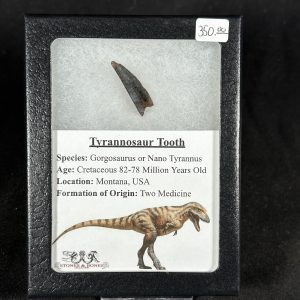
Gorgosaurus fossil bones and teeth are rare and highly prized specimens from one of North America’s most fearsome Late Cretaceous predators.
Quick Facts
| Common Name: Gorgosaurus | Scientific Name: Gorgosaurus libratus | Meaning: Fierce lizard |
| Period: Late Cretaceous (76-75 million years ago) | Diet: Carnivore | Size: Large |
| Length: Up to 9 metres (30 feet) | Weight: 2-2.5 tons | Named by: Lawrence Lambe |
Overview
Gorgosaurus was a powerful tyrannosaur that dominated Late Cretaceous North America several million years before Tyrannosaurus rex appeared. Like all tyrannosaurids it had a massive reinforced skull, powerful jaws lined with large recurved teeth, and dramatically reduced forelimbs. It is one of the best-known tyrannosaurs, represented by at least a dozen complete or near-complete skulls — many recovered from the Alberta Badlands by Royal Tyrrell Museum paleontologists.
The Royal Tyrrell Museum’s Gorgosaurus
The Royal Tyrrell Museum’s Foundations exhibit features a juvenile Gorgosaurus that is a rare example of a fully articulated specimen — bones found arranged exactly as they were in life, over 95% complete. It was discovered in Dinosaur Provincial Park in 1991. Royal Tyrrell Museum paleontologist Dr. François Therrien co-authored 2021 research demonstrating that jaw morphology and tooth shape in Gorgosaurus libratus changed as the animal matured to allow it to tackle increasingly large prey.
Diet across life stages
Research published in 2023, with Royal Tyrrell Museum scientists as lead authors, confirmed from preserved stomach contents of a juvenile Gorgosaurus that young tyrannosaurs targeted small, swift prey — eating just the legs of small dinosaurs rather than devouring whole carcasses. Adults hunted large hadrosaurs using their more robust skulls and crushing bite force. This dietary shift likely allowed tyrannosaurs to dominate both large and small predator niches simultaneously.
What to Look For
Gorgosaurus bones are rare and exceptionally sought-after collector pieces. A femur (thigh bone) from this tyrannosaurid connects you to one of the apex predators of the Late Cretaceous — a relative of T. rex that dominated its ecosystem millions of years before the iconic giant appeared. The dense, compact bone structure of large theropod limb elements makes them durable in the fossil record; look for the characteristic thick cortical wall and the large muscle attachment scars that speak to the power this animal carried.
Look for the distinctive serrated teeth with banana-shaped cross section typical of tyrannosaurs. Bone texture on genuine specimens is dense and heavy. The forelimbs are characteristically small with two functional fingers. Vertebrae show distinctive neural spine shapes that differ from T. rex.
Fun Facts
Gorgosaurus is one of the best understood tyrannosaurs due to multiple complete specimens. Juveniles had proportionally longer legs suggesting they occupied a different ecological niche than adults. It likely preyed on hadrosaurs and ceratopsians. Bite marks from Gorgosaurus have been found on prey bones at Tyrrell excavation sites.
Museum Research Articles
Learn more about the Gorgosaurus
- Royal Tyrrell Museum: Foundations Exhibit
- Natural History Museum London: Young Tyrannosaur Diet Research
- Britannica: Albertosaurus and Gorgosaurus
- Smithsonian Institution: Gorgosaurus Collection