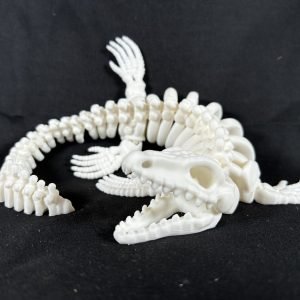
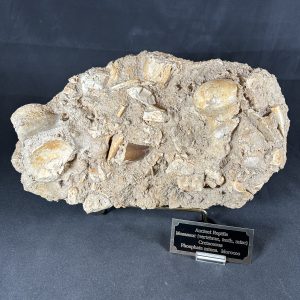
Mosasaurus fossil bones and teeth are among the most dramatic marine reptile specimens available to collectors, representing one of the largest and most fearsome predators to ever inhabit the ancient seas.
Quick Facts
| Common Name: Mosasaurus | Scientific Name: Mosasaurus hoffmannii | Meaning: Meuse River lizard |
| Period: Late Cretaceous (82-66 million years ago) | Diet: Carnivore | Size: Very Large |
| Length: Up to 17 meters (56 feet) | Weight: 14-15 tons | Named by: Gideon Mantell, 1829 |
Overview
Mosasaurus was one of the largest and most powerful marine predators of the Late Cretaceous, dominating the oceans during the final chapter of the age of dinosaurs. It was a large aquatic lizard closely related to modern monitor lizards and snakes, with a streamlined body, powerful flippers and a long paddle-like tail. Mosasaurus fossils were among the first large prehistoric reptiles ever scientifically described, with specimens discovered in the Maastricht region of the Netherlands in the late 18th century playing a key role in early debates about extinction and deep time.
Discovery & Ecology
The first Mosasaurus skull was found by Dutch miners in 1766 and debated for decades as a fish, crocodile, or whale before being named in 1822. Smithsonian Ocean researchers have used carbon isotope analysis of mosasaur teeth to reveal complex ecological partitioning — different species feeding in different water depths — that allowed so many to coexist. Both ichthyosaurs and mosasaurs have a warm body temperature similar to modern marine mammals, as confirmed by Smithsonian isotope analysis.
What to Look For
Mosasaurus teeth are among the most commonly available marine reptile fossils. Look for the distinctive conical shape with a smooth enamel surface and slight curve. Genuine teeth show fine surface ridges and a hollow root. Bone fragments are dense and heavily mineralized. Vertebrae are distinctive with a concave face on each end unlike dinosaur vertebrae.
Fun Facts
Mosasaurus was one of the first prehistoric animals to be scientifically studied, with its discovery in the 1760s predating even the word dinosaur. It went extinct at the same mass extinction event that killed the non-avian dinosaurs 66 million years ago. Its double-hinged jaws allowed it to swallow large prey whole. Some species may have given birth to live young in open water rather than laying eggs on beaches.
Museum Research Articles
Learn more about the Mosasaurus
- National Park Service: Mosasaur: Apex Predator of the Western Interior Seaway
- National Park Service: Mosasaur Jaw
- Britannica: Mosasaur
- Natural History Museum London: What is a Mosasaur?
- Smithsonian Ocean: Mosasaur Diet