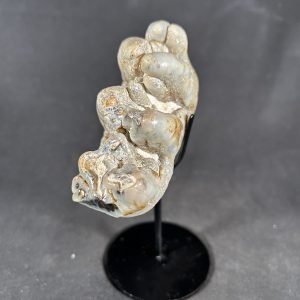
Platybelodon fossil teeth and bones are among the most visually striking prehistoric mammal specimens available, belonging to one of the most extraordinary animals in evolutionary history — the “shovel-tusked” proboscideans whose bizarre flat lower tusks and extended lower jaw have made them one of paleontology’s most iconic and debated genera.
Quick Facts
| Common Name: Platybelodon | Scientific Name: Platybelodon grangeri | Meaning: Flat tusk (from Greek) |
| Period: Middle Miocene (16–9 million years ago) | Diet: Herbivore | Size: Large — elephant-sized |
| Length: Up to ~5 m (16 ft) body length | Weight: Estimated 4–5 tons | Named by: A.A. Borissiak, 1928 |
Overview
Platybelodon was a prehistoric proboscidean — a distant relative of modern elephants — that lived across Central Asia and China during the Middle Miocene epoch, approximately 16 to 9 million years ago. It belonged to the family Amebelodontidae, the so-called “shovel-tuskers,” a group defined by their extraordinary lower jaw anatomy: a greatly extended lower jaw housing two broad, flat, shovel-shaped lower tusks quite unlike those of any other proboscidean. Elephant-sized, standing roughly 2.5 to 3 metres at the shoulder and weighing an estimated 4 to 5 tonnes, Platybelodon was one of the dominant large herbivores of the Miocene grasslands and river systems of Asia.
The function of the distinctive flat lower tusks has been one of paleontology’s long-running debates. For decades, the standard interpretation — first proposed by American paleontologist Henry Fairfield Osborn in the 1930s — held that Platybelodon used its shovel-like lower jaw to scoop up aquatic plants from rivers and lake margins. More recent dental microwear analysis of molar teeth and tusk surfaces has revised this picture significantly. Research published in peer-reviewed literature found that molar microwear in Platybelodon grangeri is consistent with browsing on leaves and twigs, and that the tusk microwear is inconsistent with shoveling substrate. Current thinking, supported by Britannica’s coverage of gomphotheres, favors a bark-stripping and branch-processing function for the tusks, with the broad flat lower jaw acting as a cutting platform against which the upper tusks could slice vegetation.
Platybelodon fossils are known primarily from the Linxia Basin in Gansu Province, China, where the Middle Miocene Hujialiang Formation has yielded over 30 partial skulls and mandibles representing multiple growth stages. Additional material comes from Mongolia, the Caucasus region, and Pakistan. The best-known species, Platybelodon grangeri, was first recovered from Mongolia by American Museum of Natural History paleontologist Walter Granger during expeditions in 1928, and was named in his honor. The genus went extinct at the end of the Middle Miocene, its woodland and floodplain habitat replaced by more open, drier environments.
What to Look For
Platybelodon molar teeth are identifiable by their intermediate crown structure — more complex than the bilophodont teeth of Deinotherium, but less heavily ridged than the multi-plated molars of woolly mammoths. Each tooth has multiple transverse ridges (lophs) separated by valleys, with cementum filling the spaces between ridges in more derived specimens. The enamel is thick and slightly textured, and the overall tooth form is elongated and robust. Chinese Miocene fossil deposits typically preserve bone and teeth in warm tan, reddish-brown, or occasionally grey tones, reflecting the fluvial sediments of the Linxia Basin and related formations where most material originates.
The most diagnostic identification feature — where jaw material is present — is the enormously extended, broad lower jaw and the characteristic flat, wide lower tusks that distinguish amebelodonts from all other proboscideans. In isolated molar teeth, the key is the combination of the loph count, crown height, and enamel texture: Platybelodon molars sit between the primitive low-crowned teeth of early proboscideans and the extreme hypsodonty of mammoths, reflecting an animal adapted to processing moderately abrasive forest browse. At 9 to 16 million years old, these teeth are substantially older than any mammoth or mastodon material and represent an evolutionary experiment in proboscidean anatomy that has no parallel in the living world. Provenance documentation is important given the range of fossil material available from Chinese deposits.
Fun Facts
Platybelodon is one of paleontology’s most recognizable and beloved animals — its bizarre shovel-shaped lower jaw and flat tusks have made it a fixture of prehistoric life books, museum displays, and popular science coverage for nearly a century. Despite this fame, science’s understanding of how it actually used those extraordinary tusks has been completely revised: modern dental microwear research has shown it was a browser feeding on leaves and twigs, not the swamp-shoveling aquatic grazer that the classic image suggested. The best-known species, Platybelodon grangeri, was discovered by American Museum of Natural History expeditions to Mongolia in 1928 and named for paleontologist Walter Granger. The Linxia Basin in Gansu Province, China, has produced so many Platybelodon fossils that the local Middle Miocene fauna is informally called the “Platybelodon Fauna.” Large fossil bones and teeth from Asian deposits including proboscidean relatives were historically sold as “dragon bones” in Chinese traditional medicine markets, reflecting the deep intertwining of fossil discovery and local cultural interpretation that preceded modern paleontology.
Museum Research Articles
- Britannica: Gomphothere — shovel-tusked proboscideans
- Britannica: Shovel-tusker — anatomy and diet
- Britannica: Proboscidean — evolution and classification
- Smithsonian Institution: Paleobiology collections
- Natural History Museum, London: Fossil mammal research
- Royal Tyrrell Museum: Cenozoic Gallery — Age of Mammals