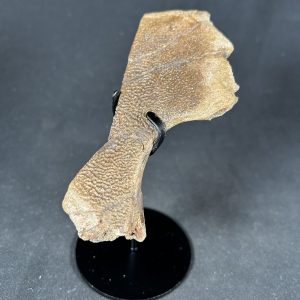
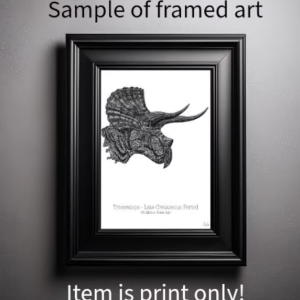
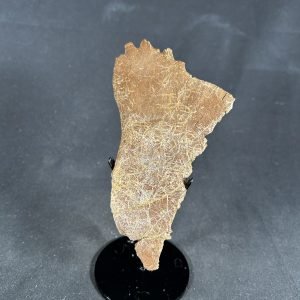
Triceratops fossil bones and teeth are among the most sought-after dinosaur specimens for collectors and natural history enthusiasts worldwide.
Quick Facts
| Common Name: Triceratops | Scientific Name: Triceratops horridus | Meaning: Three-horned face |
| Period: Late Cretaceous (68-66 million years ago) | Diet: Herbivore | Size: Large |
| Length: Up to 9 metres (30 feet) | Weight: 6-12 tons | Named by: Othniel Charles Marsh |
Overview
Triceratops is one of the most recognizable dinosaurs ever to have walked the Earth. A massive quadrupedal plant-eater, it is defined by its extraordinary skull — among the largest of any land animal — featuring two long brow horns exceeding 90 cm, a shorter nasal horn, and a sweeping bony frill nearly a metre across. It was one of the last non-avian dinosaurs to evolve, surviving right to the end-Cretaceous extinction 66 million years ago.
Anatomy
Some individual skulls approached 3 metres in length. Modern research suggests much of the skull was covered in colorful keratin in life — similar to the beaks of living birds. Hundreds of stacked shearing teeth formed efficient dental batteries, while a beak-like front allowed it to crop plants close to the ground. Unlike many other large ceratopsians found in massive bone beds, Triceratops remains are usually found as single individuals, suggesting a more solitary lifestyle.
Behaviour
Fossil evidence — including a healed horn bitten off and frill bones bearing puncture marks — confirms that Triceratops clashed with Tyrannosaurus rex and sometimes survived. Horn-scored frill bones also point to combat between males competing for mates. Fossils have been found throughout Colorado, Montana, Wyoming, and South Dakota.
What to Look For
Triceratops bones are among the most commonly recovered fossils in the uppermost Cretaceous deposits of western North America, making them more accessible to collectors than many other large dinosaurs. Limb bones such as the humerus (upper arm) are robust, well-preserved, and immediately recognizable by their size and density. Even a single bone connects you directly to one of the most famous animals in prehistoric history — a creature that charged through the final age of the dinosaurs alongside Tyrannosaurus rex.
Look for the distinctive horn cores and frill fragments. Genuine bone shows natural porosity and suture lines between bone plates. Teeth are battery-style, flat and ridged for grinding. The frill bone is characteristically thin with a wavy edge. Colour variation in genuine specimens ranges from grey-brown to dark brown depending on the formation they were found in.
Fun Facts
Over 50 skulls have been discovered making it one of the best-known dinosaurs. Its horns were made of keratin over bone and could grow over 1 metre long. It may have used its frill for species recognition and display. Triceratops teeth were self-replacing battery-style teeth capable of processing tough vegetation. Despite its fearsome appearance it was purely herbivorous.
Museum Research Articles
Learn more about the Triceratops
- Royal Tyrrell Museum: Dinosaur Hall
- Britannica: Triceratops
- Natural History Museum London: Dino Directory
- Smithsonian Institution: Triceratops Collection