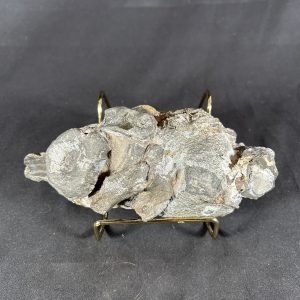
Ichthyosaurus fossil bones and teeth are among the most historically significant marine reptile specimens available, representing one of the first prehistoric creatures ever discovered and studied by science.
Quick Facts
| Common Name: Ichthyosaurus | Scientific Name: Ichthyosaurus communis | Meaning: Fish lizard |
| Period: Early Jurassic (200-175 million years ago) | Diet: Carnivore | Size: Medium |
| Length: Up to 2 meters (6.5 feet) | Weight: 90 lbs | Named by: Konig, 1817 |
Overview
Ichthyosaurus was a dolphin-like marine reptile that lived in the shallow seas covering what is now Europe during the Early Jurassic period. It is one of the most historically significant prehistoric animals ever discovered, with many of the finest specimens found by pioneering fossil hunter Mary Anning along the cliffs of Lyme Regis in Dorset, England. Ichthyosaurus was so perfectly adapted to marine life that it gave birth to live young in the water rather than coming ashore to lay eggs, a fact confirmed by fossil specimens preserving embryos inside adults.
Mary Anning & Lyme Regis
The Lyme Regis Museum stands on the very site where fossil hunter Mary Anning was born and ran her first fossil shop. It was at Lyme Regis in 1811–12 that Mary and her brother Joseph made the first scientifically described ichthyosaur discovery — a 5-metre skeleton that changed science’s understanding of extinction and Earth’s history. The Lyme Regis Museum holds a large Temnodontosaurus ichthyosaur discovered near the museum in 2011, the same species Mary Anning found 200 years earlier. The museum describes the Jurassic cliffs of Lyme Regis as uniquely preserving ichthyosaur body outlines including soft tissue — one of the finest ichthyosaur preservation localities on Earth.
Physiology
Smithsonian researchers using oxygen isotope analysis have found that ichthyosaurs maintained a warm body temperature similar to modern whales — remarkable evidence of endothermy in a reptile lineage. Extraordinary fossils have preserved the dorsal fin and tail flukes in outline, confirming a body shape almost identical to modern dolphins. Ichthyosaurs gave birth to live young in the water.
What to Look For
Lyme Regis specimens are typically preserved in dark grey limestone nodules with beautiful detail. Look for the distinctive paddle-shaped flippers with closely packed finger bones. The large eye socket with its sclerotic ring of bone plates is highly distinctive. Vertebrae are disc-shaped and tightly packed. Genuine specimens from Lyme Regis have a characteristic dark grey to black mineralization.
Fun Facts
Mary Anning discovered her first Ichthyosaurus at just 12 years old on the Lyme Regis coast. Fossils preserving skin show Ichthyosaurus had a dorsal fin and crescent shaped tail like a modern tuna, features not visible in the skeleton alone. It could dive to considerable depths thanks to large eyes protected by a ring of bony plates. A new species was named Ichthyosaurus anningae in honor of Mary Anning in 2015.
Museum Research Articles
Learn more about the Ichthyosaurus
- Lyme Regis Museum: Ichthyosaurus anningae Named After Mary Anning
- Lyme Regis Museum: Mary Anning Collection
- Lyme Regis Museum: Fossil Collection
- Natural History Museum of Utah: Whale-Sized Marine Reptiles Research
- Britannica: Ichthyosaur
- Natural History Museum London: What is an Ichthyosaur?
- Smithsonian Ocean: Sea Lizard Physiology