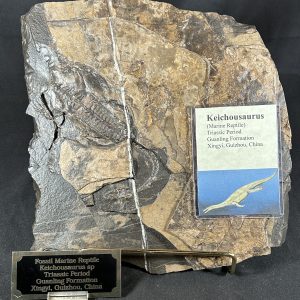
Keichousaurus fossil specimens are among the most complete and visually stunning small marine reptile fossils available to collectors, often preserved as entire skeletons in fine-grained limestone.
Quick Facts
| Common Name: Keichousaurus | Scientific Name: Keichousaurus hui | Meaning: Kweichow lizard |
| Period: Middle Triassic (245-228 million years ago) | Diet: Carnivore | Size: Small |
| Length: Up to 30 cm (12 inches) | Weight: Under 1 lb | Named by: Young, 1958 |
Overview
Keichousaurus was a small nothosauroid marine reptile that lived in the shallow coastal seas of what is now Guizhou Province in southwestern China during the Middle Triassic period. It is one of the most commonly found complete fossil reptiles in the world, with thousands of specimens recovered from the Triassic limestone beds of China. Many specimens preserve extraordinary detail including embryos inside adults confirming that Keichousaurus gave birth to live young rather than laying eggs. It is a popular collector species precisely because complete articulated skeletons are relatively available compared to most prehistoric reptiles.
Reproductive biology
Keichousaurus is scientifically notable for providing some of the earliest evidence of live birth in a marine reptile — fossils have been found with embryos preserved inside the body cavity. This indicates that at least some nothosaurs, like later ichthyosaurs, bore live young rather than returning to land to lay eggs — an early adaptation to a fully aquatic lifestyle.
What to Look For
Complete articulated skeletons are the most desirable form. Look for the distinctive long neck with numerous small vertebrae, four slender limbs and a long tapering tail. Genuine specimens from China are preserved in fine grey limestone with excellent bone detail. Note: composites assembling bones from multiple individuals are common in the market — look for consistent bone color and matrix across the entire specimen. Repair and restoration should always be disclosed.
Fun Facts
Keichousaurus is one of the few prehistoric reptiles where complete specimens including embryos have been found confirming live birth. Males and females can be distinguished by their bone proportions making it one of the few sexually dimorphic fossil reptiles identifiable in the field. Despite being only 30 cm long it was an active predator of small fish and invertebrates. Thousands of complete specimens have been found making it unusually accessible to collectors and researchers alike.
Museum Research Articles
Learn more about the Keichousaurus
- Britannica: Nothosaur